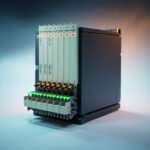
The Mitsubishi R Series PLC stands as one of the most advanced and reliable programmable logic controllers in the industrial automation market today. Designed by Mitsubishi Electric, a global leader in factory automation solutions, the MELSEC iQ-R Series represents the next generation of control systems built for high-performance, scalable, and complex manufacturing environments. This article provides an in-depth exploration of the R Series PLC, covering its architecture, key features, specifications, applications, and why it has become a preferred choice for engineers and system integrators worldwide.
With industries demanding faster processing, tighter synchronization, and greater data handling capabilities, the Mitsubishi R Series PLC delivers cutting-edge performance through its modular design, multi-CPU configuration, and seamless integration with industrial networks such as CC-Link IE, EtherNet/IP, and PROFINET.
What is the Mitsubishi R Series PLC?
The Mitsubishi R Series PLC, officially known as the MELSEC iQ-R Series, is a high-end modular programmable logic controller introduced as the successor to the popular Q Series. It is designed to meet the demanding requirements of modern industrial automation, including high-speed control, large-scale data processing, and enhanced system resilience. The platform combines a powerful CPU, advanced motion control, robust safety functions, and information networking capabilities within a compact and flexible architecture.
Key Features of the Mitsubishi R Series PLC
The R Series comes packed with a wide range of features that set it apart from traditional PLC systems:
- High-Speed Processing: Instruction execution speeds as low as 0.98 nanoseconds for basic operations, enabling real-time control of complex processes.
- Multi-CPU Architecture: Supports up to four CPUs in a single rack, allowing simultaneous execution of sequence control, motion control, and information processing.
- Modular Design: Highly scalable configuration with a wide selection of CPU, I/O, motion, and communication modules.
- Advanced Motion Control: Integrated motion modules supporting up to 64 axes of synchronized control with nanosecond-level precision.
- Built-in Safety Functions: Dedicated safety CPUs and modules compliant with IEC 61508 SIL 2 and ISO 13849-1 PL e standards.
- High-Capacity Memory: Program memory up to 1200 KB, device memory up to 4180 KB, and expanded data register capabilities.
- Robust Networking: Native support for CC-Link IE TSN, CC-Link IE Field, Ethernet, and seamless connection to SCADA/MES systems.
Technical Specifications
Below is a summary of the core technical specifications of the Mitsubishi R Series PLC:
| Parameter | Specification |
|---|---|
| CPU Types | R00, R01, R02, R04, R08, R16, R32, R120 |
| Basic Instruction Speed | 0.98 ns (R32/R120) |
| Program Memory | Up to 1200 KB |
| Device Memory | Up to 4180 KB |
| Number of I/O Points | Up to 4096 (per CPU) / 32,768 (with remote I/O) |
| Motion Control Axes | Up to 64 axes per module |
| Communication Protocols | CC-Link IE TSN, CC-Link IE Field, Modbus TCP, EtherNet/IP, PROFINET |
| Safety Compliance | IEC 61508 SIL 2, ISO 13849-1 PL e |
| Programming Software | GX Works3 |
CPU Module Variants
The Mitsubishi R Series offers a range of CPU modules tailored for different performance and application needs:
- R00/R01/R02 CPUs: Entry-level models designed for small to medium applications, offering cost-effective performance without compromising reliability.
- R04/R08/R16 CPUs: Mid-range CPUs ideal for advanced motion control and high-speed sequence processing.
- R32/R120 CPUs: High-performance CPUs for large-scale, complex systems requiring maximum I/O points and fastest processing speeds.
- Safety CPU (R08SFCPU): Dedicated safety processor that integrates safety and standard control in a single system.
- Process CPU (R08PCPU): Optimized for process automation with enhanced PID and loop control capabilities.
Networking and Communication
The Mitsubishi R Series PLC excels in connectivity, supporting both Mitsubishi’s proprietary networks and open industrial protocols. The integration of CC-Link IE TSN (Time-Sensitive Networking) enables deterministic real-time communication, combining high-speed motion control, standard I/O, and safety data on a single network cable. This significantly reduces wiring complexity and improves system flexibility.
Additional communication options include:
- Ethernet: 1 Gbps built-in port for high-speed data exchange with upper-level systems.
- CC-Link IE Field: Distributed I/O network for flexible device integration.
- Serial Communication: RS-232 and RS-485 modules for legacy device support.
- OPC UA Server: Direct IT/OT integration with MES and ERP systems.
Programming with GX Works3
The Mitsubishi R Series is programmed using GX Works3, Mitsubishi’s flagship engineering software. This powerful tool offers a user-friendly interface, intuitive drag-and-drop functionality, and support for multiple programming languages including ladder logic, structured text (ST), function block diagram (FBD), and sequential function chart (SFC). GX Works3 also includes advanced features like parameter-based module configuration, automatic label generation, and integrated simulation tools that significantly reduce development time.
Applications of the Mitsubishi R Series PLC
The versatility and performance of the R Series make it suitable for a wide range of industrial applications, including:
- Automotive Manufacturing: Body assembly lines, painting robots, and conveyor systems.
- Semiconductor Production: Wafer handling, lithography, and ultra-precise motion control.
- Food and Beverage: High-speed packaging, bottling, and quality inspection systems.
- Water Treatment: SCADA-integrated process control and remote monitoring.
- Energy and Power: Substation automation, renewable energy systems, and smart grid applications.
- Pharmaceutical: GMP-compliant manufacturing with full traceability.
Mitsubishi R Series vs. Q Series
Many users transitioning from older systems often compare the R Series with the legacy Q Series. Here’s how they differ:
| Feature | Mitsubishi Q Series | Mitsubishi R Series |
|---|---|---|
| Processing Speed | 9.5 ns (basic instruction) | 0.98 ns (basic instruction) |
| Programming Software | GX Works2 / GX Developer | GX Works3 |
Network Support
Sign in
Create an Account
|